
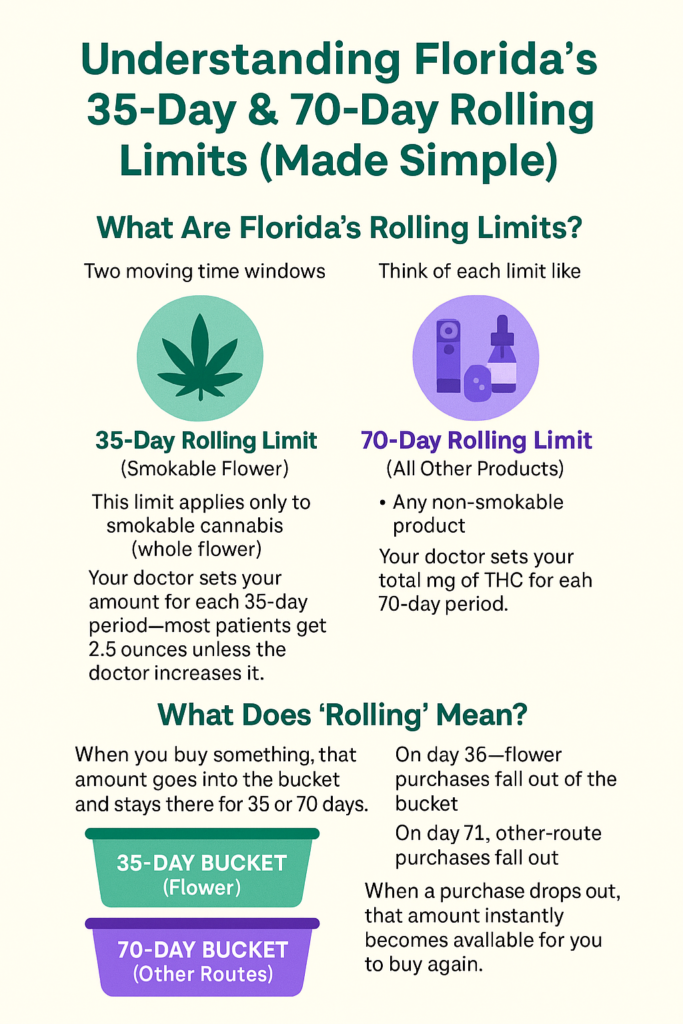
If you’re a Florida medical marijuana patient, understanding MMUR rolling allotments can feel confusing—especially when dealing with 35-day flower limits and 70-day aggregate limits.
Unlike traditional monthly prescriptions, Florida’s Medical Marijuana Use Registry (MMUR) uses a rolling calculation system, meaning your available dispensable amount changes daily based on prior purchases.
Understanding how these allotments work can help you avoid running out of medication, plan dispensary visits better, and know whether you may qualify for a Request for Exception (RFE) for higher limits.
Patients should also know how to renew medical cannabis card in Florida to maintain uninterrupted access to treatment.
What Is the Florida MMUR Rolling Limit?
To better understand the advantages of staying compliant, review the Florida medical marijuana card benefits available to patients over specific rolling periods.
There are two standard limits:
Smokable Flower Limit
- Up to 2.5 ounces
- Measured over 35 rolling days
Aggregate (Non-Smokable) Limit
- Up to 24,500 mg THC
- Measured over 70 rolling days
Formula (How Rolling Limits Work)
Available Limit = Total Allowed – Purchases Made Within Active Rolling Window
Every purchase remains in your allotment “bucket” until its rolling window expires.
Why Florida MMUR Limits Matter
Understanding these limits matters because they directly affect:
- Whether you can complete a dispensary purchase
- How often you can buy flower or concentrates
- Whether you may need an RFE increase
- How your physician structures your recommendations
Since limits roll daily instead of resetting monthly, misunderstanding them can leave patients unexpectedly unable to purchase medicine. Many of these misunderstandings are covered in medical cannabis myths vs facts Florida.
The 35-Day Rolling Limit for Smokable Flower
How the Flower Bucket Works
Standard flower allotment:
- 2.5 ounces every 35 days
Each flower purchase starts its own 35-day timer.
Example:
If you buy:
- 1 ounce on March 1
- 0.5 ounces on March 10
Your available amount decreases until:
- April 6 → first 1 ounce rolls off
- April 15 → 0.5 ounce rolls off
Then those amounts become available again.
Factors That Impact Flower Availability
Several factors can affect how much flower remains available:
| Factor | Impact on Allotment |
| Purchase Frequency | Faster usage reduces availability |
| Purchase Quantity | Large orders fill allotment quickly |
| Rolling Dates | Limits restore daily as purchases expire |
| Active Physician Orders | Expired orders can block access |
The 70-Day Aggregate Limit Explained
The 70-day aggregate limit covers all non-smokable routes.Patients comparing treatment options can also review medical cannabis vs prescription drugs Florida before choosing products :
- Inhalation (vapes)
- Edibles
- Oral tinctures
- Sublingual oils
- Topicals
Standard aggregate cap:
24,500 mg THC every 70 days
How It Works
Every product’s THC content counts toward one shared “aggregate bucket.”
Example:
| Product | THC Amount |
| Vape Cartridge | 800 mg |
| Gummies | 500 mg |
| Tincture | 1000 mg |
Total used:
2,300 mg deducted from 24,500 mg cap.
Those milligrams return on day 71 after each purchase.
Request for Exception (RFE): Higher MMUR Limits
For patients with qualifying medical needs, a physician may submit a Request for Exception (RFE) to increase standard limits.
Potential Increased Limits
| Product Type | Standard Limit | RFE Limit |
| Smokable Flower | 2.5 oz | 5 oz |
| Inhalation | 24,500 mg aggregate | 42,000 mg |
| Total Aggregate | 24,500 mg | 70,000 mg |
With supporting medical documentation, this may improve treatment continuity for higher-need patients.
How to Improve Your MMUR Allotment Management
Here are practical ways to avoid running out:
Review Purchases Regularly
Check your MMUR profile before shopping to monitor dispensable amounts.
Space Out Purchases Strategically
Avoid maxing out your allotment too early in the rolling cycle.
Track High-THC Products
Vapes and concentrates can consume aggregate limits quickly.
Renew Orders Before 210-Day Expiration
Expired physician orders can interrupt access.
Consider an RFE Review
If standard limits are insufficient, discuss increased allotments with your physician.
Common Mistakes Patients Make
Avoid these common MMUR errors:
Confusing Rolling Limits With Monthly Resets
Limits do not reset on the first of the month.
Ignoring Aggregate THC Usage
Patients often monitor flower but overlook THC totals.
Waiting Until Medication Runs Out
By the time many patients notice, purchases may be blocked.
Letting Orders Expire
An expired recommendation can pause access entirely.
What Impacts MMUR Eligibility for Increased Limits?
Several factors may affect whether higher limits are justified:
- Severity of condition
- Treatment history
- Symptom management needs
- Prior cannabis dosing response
- Supporting medical records
A physician review determines whether an RFE is appropriate.
Final Thoughts
Florida’s MMUR limits can seem complicated, but once you understand the 35-day and 70-day rolling system, they become much easier to manage.
By monitoring your dispensable amount, planning purchases strategically, and exploring a Request for Exception when needed, you can maintain consistent access to treatment.
If you need help understanding your allotment or qualifying for higher limits, CannaCare Wellness can help guide you.Learn more about how medical cannabis is transforming healthcare and why personalized treatment matters
Schedule a MMUR Consultation Today
FAQs
Q1: What is Florida’s flower purchase limit?
Most patients can purchase up to 2.5 ounces in any 35-day rolling period.
Q2: What does the 70-day aggregate limit cover?
It includes vapes, edibles, tinctures, oral products, and other non-smokable routes.
Q3: Does my allotment reset monthly?
No. Florida uses rolling allotments, not calendar-month resets.
Q4: Can I get more than 2.5 ounces?
Yes, some patients may qualify for a Request for Exception (RFE).
Q5: How do I check my remaining allotment?
Log into your Florida MMUR patient profile to view your dispensable amount.
Q6: Can a doctor help increase my limits?
Yes, a qualified medical marijuana physician may submit an RFE request.